Beckingham Hall is not, and has never been
within Goldhanger parish, It is in the parish of Tolleshunt Major, but it is
sufficiently close to Goldhanger and has many historic connections with the
village to justify its inclusion in this Goldhanger
Past website. For example, the estate of Beckingham estate once included Follyfaunts, Longwick,
Highams, Joyces, Manor Farm, and probably
Rockleys Farms, all on the parish boundaries and having connections with the
village. Beckingham Hall was also once the most impressive Tudor building for
miles around that in itself justifies a place in our local history...
|
A
drawing on the original Hall |
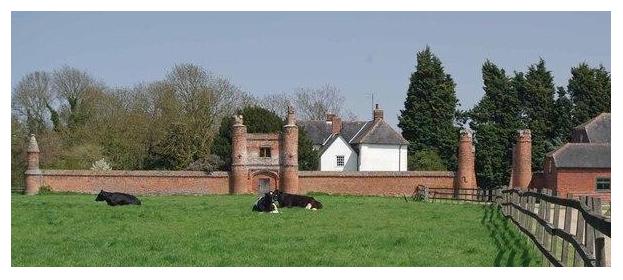
The perimeter wall and gatehouse in
1916with the later farmhouse behind |
|
|
watch an introductory video... at... www.youtube.com/watch?v=7szuhTdAFqg |
|
|


Sadly, the original Tudor Hall disappeared in
the 1700s, probably having demolished as the result of a fire. It has been
described as a “Fortified Manor House”, with both an outer protective wall and a
moat, the combination of which surrounded and protected the entire house. The
text on the drawing above indicates it to be a “Prospect from ye West”, taken
from a map of 1657, but recorded as drawn in 1905. If it is the church tower
behind the Hall, which seems likely, it has been incorrectly placed. The moat
can be seen to the left of the Hall and the Blackwater Estuary can be seen in
the background. As well as the drawing and photo above which shows the more
modern farmhouse behind the wall, the three maps below (which can be enlarged) give clues to the
grandness of the original building...
|
1709
map |
1875
map |
1890s
map |


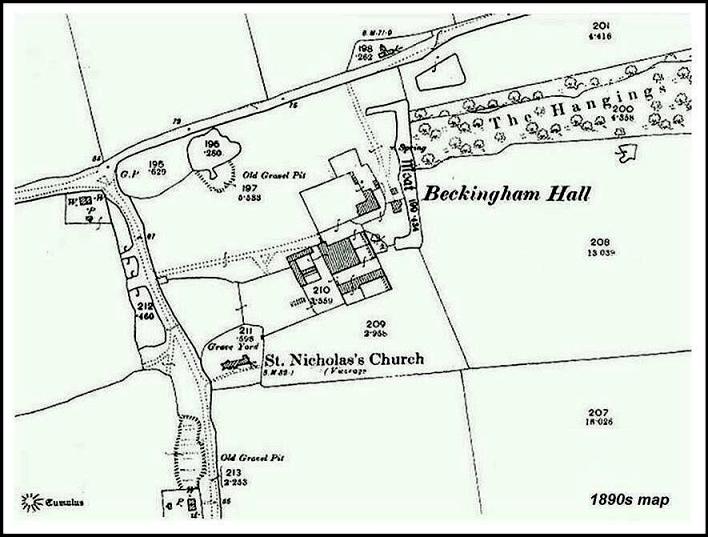
Unfortunately the 1709 map does not reveal
much about the Hall, other than it shows a much a larger building than is shown
on later maps. No moat is shown, and there appears to be two large buildings at
the side of Church Road with curved frontages that don’t appear on later maps.
These are probably a representation of the gatehouse. The Church is shown on
this map with the family chapel extending into the land adjacent to the Hall.
The 1875 map clearly shows the replacement farmhouse and many more
outbuildings. The moat can be seen on both the 1875 map and the 1890s map. A
detailed description of the hall that refers to maps and drawings in ERO is
given in...
www.britishlistedbuildings.co.uk/101328223-beckingham-hall-tolleshunt-major
Perhaps the best know relict of the original
Hall that demonstrates how grand the Hall originally was, is the oak panel that
is prominently displayed in the Victorian and Albert Museum in London. . .

The panel is thought to have formed an
over-mantel to the chimney-piece in the hall or principal apartment, and is
said to have been saved from fire which destroyed the Hall. The superbly-carved
renaissance ornament of scrolling stems, boys and dolphins has been combined
with the arms of the Beckingham family, and the arms of Henry VIII, so as to
promote the family's own status, and their loyalty to the King, who had granted
them the manor in 1543.
The family motto is inscribed in Latin, which
translates as ‘Ingratitude is death’. It has been suggested that members of the
Beckingham family, specifically the first Stephen Beckingham and his son also
Stephen, are portrayed in the sculpture. The sculpture was bought by the
V&A from The New England Company in 1912 for £370. Henry’s coat of arms in
the centre upper panel and the Beckinghams coat of arms in the lower central
panel can be seen in detail in these drawings. . .
|
Henry VIII coat of arms |
Beckingham family coat of arms |


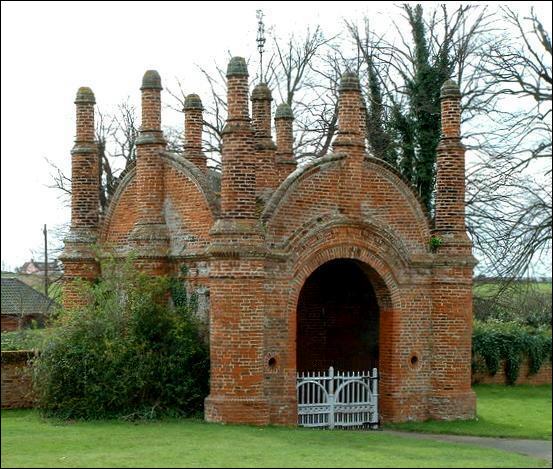
The
most notable remaining structure at the site is the much
painted Tudor gatehouse which has been recorded by many artists over the
last 200 years. It has also frequently been photographed...
|
|
|
|
|
The Gatehouse 100 years ago |
The gatehouse, gateway and walls in
2000 |
|


At seems that at one time the outer walls
were elaborately decorated...
|
|
|


Sgraffito or sgraffiti is a technique of wall
decoration of Italian origin, produced by applying layers of plaster which are
tinted in contrasting colours. It can also be made in tile form. Small samples
of the work on the outside of the gatehouse have remained into the 20th century
and appear to be two contrasting black and white tile like decorations running
in bands around the front, as seen above. The following two extracts describe
the same external decoration as “pencilling” and “Ruddling” and indicate that
the it was, and still is unusual...


This extract from Miller
Christy’s Handbook for Essex
published in 1887 has an interesting description of the wall and gateway...

extracts from... English homes - Early Tudor: 1458-1558, by H. Avray Tipping in 1921
...It is
unlikely that the Beckingham panels, although no doubt wrought in England for
Stephen Beckingham, are by an English hand. The sculpture of the scrollwork,
birds, beasts and boys, is of high order, and although there were Englishmen in
Henry VIII's time who could produce work of greater finish than that at
Tolleshunt Darcy, yet the deft elegance and mastery shown in the Beckingham
panels are rather such as was possessed by the Italian and French carvers who
found employment in England.
...The
dwelling stands in a remarkable enclosure of Early Tudor brickwork, forming a
court or garden over a hundred feet square. In the centre of the west side is a
ruined gatehouse, of which the archway (now filled in) was not of width to
allow more than a man on horseback to pass through. The upper floor was reached
by a narrow stair in the thickness of the south wall, and from the room thus
reached another flight conveyed to the roof. The room was lit towards west and
east by three-light, arch-headed windows, and towards north and south by
squints. The fireplace flue was carried up into one of the corner circular
turrets, two of which are hollow with arched entrances to their exiguous space.
The same
arrangement is found at the north-west corner of the enclosure, where a tiny
garden alcove occupies the bottom section of the conically topped turret.
Beyond the south wall of the enclosure a broad cartway, once arched over, is
flanked by tall turrets with embattled parapets, such as we also see on the
inner turrets of the gatehouse. On the gatehouse walls are still portions of
original plasterwork painted in bands of black-and-white geometric patterns.
...The
enclosing wall has a fine diaper of burnt ends. Smallish triangles rise from
the plinth, and from the apex of every other one of these rise larger
triangles. The wall is topped with an ample coping set on an over-sailing,
toothed course, and the whole composition is one of dignified mass, relieved by
interesting details.
|
The tower attached to St. Nicholas church
next the Hall was built by Sir Stephen Beckingham at the same time as the
Gate House, and is built of the same type of Tudor red brick with blue brick
diapering. Historian Nikolaus Pevsner wrote that the tower is
disproportionately large compared the nave of the Church... |
|

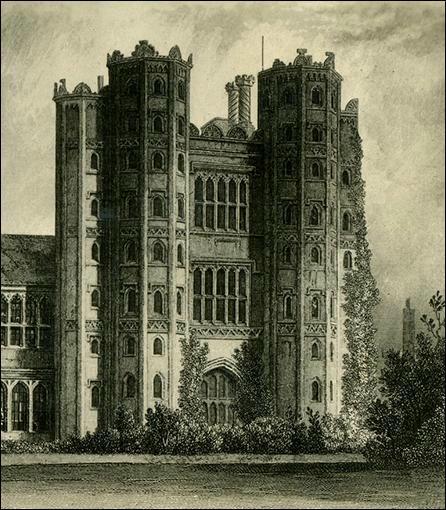
One
wonders how unique the Beckingham Hall gatehouse is and if there are, or were,
any similar structures nearby. Layer Marney Tower is certainly the nearest
Tudor building and has a large impressive gatehouse. The Palace of Beaulieu, a
former royal establishment at Boreham, also called New Hall and is now New Hall
School, also once had an impressive gatehouse, but both of these gatehouses
were part the main buildings...
|
Layer
Marney Tower |
New
Hall
gatehouse |
|

However,
three other ancient gatehouses have been identified in the eastern region which
appear to have a much closer in resemblance to the Beckingham gatehouse. The
Abbeygate at Thetford priory, is older at c.1400 and not built of red brick.
Erwarton Hall gatehouse near Shotley in Suffolk was built at the same time as
Beckingham Hall and Nikolaus Pevsner described that gatehouse as “similar to that of Beckingham Hall which can
be dated c1545 with certainty”. The gatehouse with even greater similarity
however is the Water Gate at Cardinal Thomas Wolsey's ill-fated “Cardinal’s
College of Saint Mary” which is in College Street, Ipswich, close to the river.
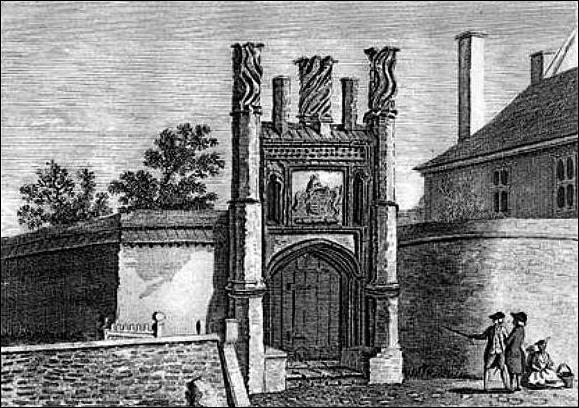
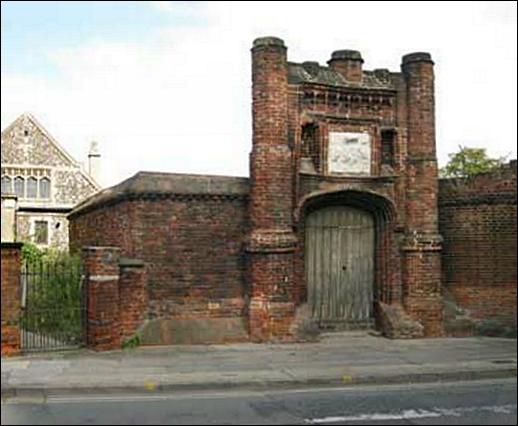
All the college buildings were destroyed by Henry VIII, but the gatehouse
remains but with its chimneys and pinnacles missing, and is of a similar
appearance, even with similar adjacent boundary walls.
Neither
the Water Gate at Ipswich nor Erwarton Hall gatehouses have any signs of
windows, so had no accommodation for a gatekeeper as at Beckingham Hall.
However the Abbeygate at Thetford does have windows...
|
Abbeygate
at Thetford priory |
Erwarton
Hall Gatehouse at Shotley |
|
|
Wolsey's
original Water Gate |
The
Water Gate at Ipswich today |
|

Strangely,
and perhaps not a coincidence, at the time of the Reformation
there was a local connection between Cardinal Thomas Wolsey and Tolleshunt
Major. Cardinal Wolsey was gifted The Priory on Tiptree Heath and Wykes Manor
in Tolleshunt Major by Henry VIII for his efforts in closing down the
Augustinian Priory and evicting the “Black Canons”.
Here
is an extract from Philip Morant’s History
and Antiquities of Essex, dated 1768 given on pages 390 & 391 and
adjacent to the Morant’s description of Beckingham Hall....
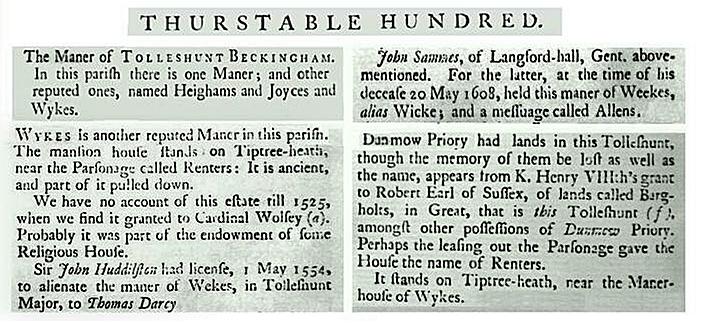
Now called Wicks Manor, it is located on the opposite side of Tolleshunt Major
on the Beckingham Road just a half mile away. Cardinal Wolsey(1585–1596) and
Stephen Beckingham(1518-1588) must have know each other and could well have
shared architectural ideas.
|
Another
historical artefact that connects Cardinal Wolsey, Wicks Manor and Beckingham Hall, is possibly the bookplate
shown here. It changed hands at Bonhams auctioneers in 2012 as part of the
large collection of early bookplates belonging the late Arthur Dorling of
Woodford who was a renowned collector of such material. The
annotation at the top of the plate reads "Wykes - Tiptree Heath”.
Despite Cardinal Wolsey’s association with Wykes Manor, the coat-of-arms has
little or no resemblance to the various coat-of-arms of Cardinal Wolsey but
does have similar elements to the Beckingham family coat-of-arms. This would
suggest that at some stage Wykes Manor belonged to the Beckingham family. |
|

Recent and old photographs, lithographic drawings from the early
1800s, and other historic information from various sources given on this
webpage enable us to envisage what the gatehouse might of looked like when it
was originally built, and in turn give some clues to the appearance of the
original Hall, as it is unlikely that the gatehouse was more ornate than the
Hall. The castle-like gatehouse originally had chimneys built into the two
front turrets, with two matching ornate rear castellated turrets (also
replicated on the gateway turrets close by), and castellated top edges on all
four sides. The early drawings
also show the front turrets with small castellations and signs of two bands of
decorative black and white sgraffito tiles arounded the outside. The entrance
arch would probably not have been filled with brickwork and a plain wooden
door. The Tudor brick arch top and window tops are the same design as the
windows in the church tower. The perimeter wall had prominent blue brick
diapering also matching up with the church tower...

a computer art impression of the
original gatehouse
______________________
A timeline of know events and milestones
1150s The
estate was given to Coggeshall Abbey by Godfrey de Darcy, also known as Godfrey
de Tregoz
1536 Coggeshall
Abbey was dissolved
1537 The manor was rented
to a John King
1544 Henry
VIII sold it to Stephen Beckenham and his wife Anne, together with Follyfaunts and Longwick,farms
for £929.
The Charter granted to Stephen Beckingham by
Henry VIII for the sale is held in the
London Metropolitan Archive in London...

1545 Stephen Beckingham built the tower on
St Nicholas Church
1546 Wooden
panelling from Beckingham Hall displaying this date is in the V&A,
(purchased in 1912).
1574 Sir
Thomas Beckingham, (c.1574-1633), of Tolleshunt Major, Essex
“His grandfather acquired the Essex manor of
Tolleshunt Major from the Crown in 1543, and thereafter this property was s
known as Tolleshunt Beckingham. He owed his election to the first Stuart
Parliament for Sudbury to his father-in-law, Sir William Waldegrave, whose
family had been electoral patrons in the borough in the Elizabethan period. He
was also a neighbour of the Darcy family.”
1609 A
family chapel and mausoleum was built on the north side of St Nicholas Church
with kneeling effigies of Stephen Beckingham and his wife with their heraldic
shield. It was pulled down later when the Beckinghams sold the estate.
1609 Stephen
Beckingham constructed a heraldic shield in the church which featured
statuettes of himself and his wife Alvis Beckingham (née Terral).
1613 Sir
Thomas Beckingham was removed from the Essex bench and received a licence to
travel for three years, which might suggest he was in debt.
1620 Sir Thomas Beckingham sold parts of the
estate to Christopher Clitherow.
1636 The Beckingham family sold the Hall to
Sir Thomas Adams.
1647 Sir
William Adams, son of Sir Thomas Adams, sold it to Thomas Fox, a London
cheesemonger.
1710 Thomas
Fox’s wife re-married and the Hall was acquired by the Revd. Dr. Daniel
Williams.
1711 The
Revd. Dr. Williams left Beckingham Hall in trust to
the New England Company.
1753 The Beckinhams were
in residence in the Hall at this time as noted in The Gentleman’s Magazine of
1797
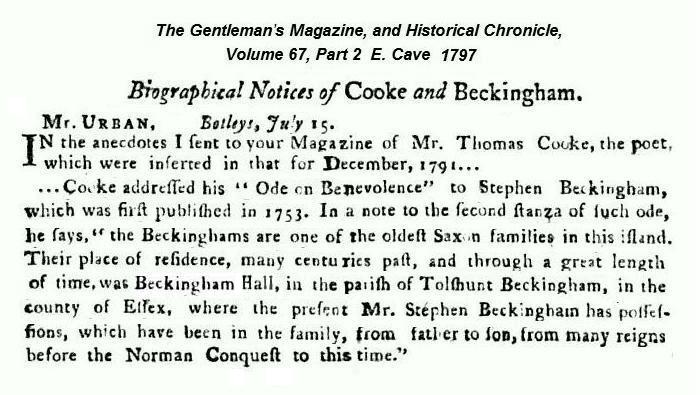
and
are referred to as “one of the oldest Saxon families in this island”.
1782 The
Hall was demolished and replaced by a much smaller farmhouse. (Wikipedia)
1783 The Beckingham family still owned the
lands at this time.
1700s The
Sir Stephen Beckingham Trust gave £2 per year out of Freme Farm, but not
paid since 1815 (White's 1848 Directory)
1870s Ernest Page farmed Beckingham estate, he
was the brother of Charles Page of Old Rectory Farm, Goldhanger.
1880s James A Piggot farmed
420 acres of the Beckingham estate, employing 22 men and 4 boys
and
was know at the time as “Baron Piggot”
______________________
Several Stephen
Beckinghams were associated with the Hall
Typical for the period, and confusingly now,
the first name Stephen was passed down through several generations of the
family. They were all wealthy educated professionals, well known in their day
and have historical records...
Stephen Beckingham the 1st (1518-1588) original owner
married three
times:
1. Anne Unton
(m.1538, d. about 1550) - mother of Thomas (c1540-1596), Mary,
Alice, Thomasin, Elizabeth
2. Elizabeth Browne
of Wiltshire (d about 1554) (m.about 1550) - mother of Stephen (1550-1611)
3. Johanna of
Bygrave Herts (d.1588) (m.about 1555)
Stephen Beckingham the 2nd (1550-1611) married to Avice Tyrrell
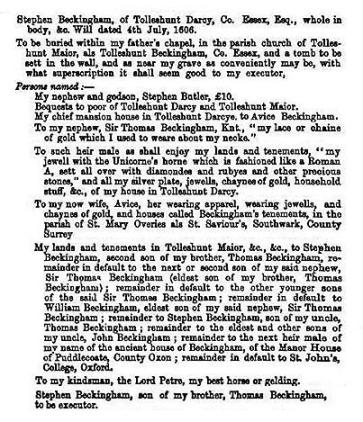
Here is an extract from Stephen Beckingham
the 2nd‘s Will, which reveals both their wealth
and their complex family relationships using
the same first names...
Stephen Beckingham the 3rd was admitted in 1665 as a
Fellow-Commoner at Jesus College Cambridge.
This Stephen Beckingham of Tolleshunt Darcy
was made a barrister in1671.
Stephen Beckingham the
4th
(c1697-1756) lived at Bourne place, Bishopsbourne, Kent
Stephen Beckingham’s wedding to Mary Cox in
1729 was recorded by Hogarth...

Stephen Beckingham the 5th (c1729-1813) of Bourne Place,
Bishopsbourne, Kent,
was the son of Stephen Beckingham the 4th.
This Stephen Beckingham was painting by
the famous artist P G Batoni (1708-87) in
1752-3...

______________________
extracts from... http://www.kentarchaeology.org.uk/Research/Pub/ArchCant/Vol.046%20-%201934/046-12.pdf
The Ancient Stained Glass In Bishopsbourne Church, Kent
written by N E Toke in 1934 and
recorded by Kent Archaeological Society
...The fine Renaissance
glass in the St. Catherine's Chapel, was inserted
by the Beckingham family, who owned Bourne Place in the eighteenth
and nineteenth centuries. The estate was originally the seat of Sir Anthony
Aucher who died in 1692 leaving two sons. On the death of the younger of these
in 1726 the estate devolved to their sister Elizabeth, the wife of John Corbet,
Esq. of Shropshire, who died in 1736. The latter's eldest daughter Mary
Catherine, became the owner of Bourne Place, and carried it with a marriage to Stephen Beckingham, who died in 1756. The
Beckinghams then held Bourne Place until 1844...
A series of tablets, ten on either side of
the window, commemorates members of the Aucher and Beckingham families
beginning with Sir Anthony Aucher, Master of the Jewel House in the times of
Henry 8th, Edward 6th, and Queen Mary, slayen at the loss of Callis" in
1558, and ending with Miss Louisa Beckingham, who died in 1844...
The heraldic glass bears the date 1550, and
was probably brought from Beckingham Hall in
Tolleshunt Major, Essex, where the family of Beckingham
was seated at one time...
In Mr. Herbert Cole's Heraldic and Floral Forms used in Decoration there is an
illustration of a carved oak panel from Beckingham Hall. It shows the arms of Henry
VIII and the date 1546. These panels are illustrated also in "Early English Furniture and Woodwork"
by H. Cescinsky and E. R. Gribble, who state that they are probably the work of
Walloon craftsmen resident in Essex. The panel is are now in the Victoria and
Albert Museum, South Kensington...
The lower portion of the window in the Church
is divided into three of which the two lateral ones contain six shields, three
on either side, ith the arms of Beckingham and their various impalements. The
centre portion contains the Royal Arms, as borne by the Tudors, together with
two finely-wrought pieces of seventeenth century Dutch glass...
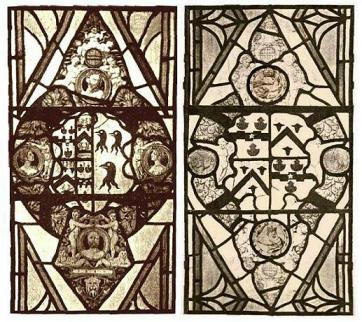 The shield (on the left of this photo)
is dated 1550. It bears : Beckenham,
impaling: Argent, three rooks' heads erased, sable, and for Sharpe of
Essex. The lowest shield is undated, and is ornamented at the top with a mauve
coloured medallion containing the bust of a Queen holding a sceptre, and at the
bottom with a similar medallion with the bust of a King with a sceptre. Medallions
on either side contain, respectively, a warrior brandishing a sword, and what
appears to be a Tartar warrior in a quilted tunic. It bears: Beckingham,
impaling: Azure, on a fess, or, a greyhound courant, sable, between three
spearheads of the second, for Unton...
The shield (on the left of this photo)
is dated 1550. It bears : Beckenham,
impaling: Argent, three rooks' heads erased, sable, and for Sharpe of
Essex. The lowest shield is undated, and is ornamented at the top with a mauve
coloured medallion containing the bust of a Queen holding a sceptre, and at the
bottom with a similar medallion with the bust of a King with a sceptre. Medallions
on either side contain, respectively, a warrior brandishing a sword, and what
appears to be a Tartar warrior in a quilted tunic. It bears: Beckingham,
impaling: Azure, on a fess, or, a greyhound courant, sable, between three
spearheads of the second, for Unton...
The shields (in the right on this photo)
compartment are almost identical with those on the left as far as the
ornamentation round them is concerned. The uppermost one is dated 1550, and
bears : Beckingham, impaling : Argent, three hawks' lures, sable, for Bromwich.
The centre one bears: Beckingham, impaling: Azure, chevron between three escallops, for Browne
of Horton Kirby, Kent. The shield has the arms of Beckingham alone...
Note: Bourne place, Bishopsbourne was the
Beckingham family seat in the 1700 &1800s and today is called Bourne House.
______________________
John Marius Wilson's Imperial Gazetteer of England, and Wales in 1870-72 recorded the
following, and is another indication of the Beckingham legacy and the family’s
connection with Kent...
TOLLESHUNT-MAJOR,
or Beckingham, in Maldon district... A seat of the Beckinghams was erected here
in the time of Henry VIII., and is now represented only by an embattled
gateway. The living is a vicarage in the diocese of Rochester. Value £187.
______________________
Some on the information on this webpage is
taken from:
Miller Christy’s
Handbook for Essex published in 1887
History
and Antiquities of Essex by Philip Morant dated 1768, page 390
Tolleshunt
Major in words and pictures by Karen Tuke in 2002, Essex libraries reference:
E.TOL.4
The
History of Beckingham
a booklet published by W L Hall in 1936
Early
English Furniture & Woodwork by Herbert Cescinsky & Ernest. R.
Gribble in 1922
The
Priory of Dartford and The Manor House of Henry VIII by A W Clapham In 1926
English
Medieval Industries: Craftsmen Techniques, Products by J Blair & N
Ramsay in 1991
http://collections.vam.ac.uk/item/O140692
http://www.kentarchaeology.org.uk/Research/Pub/ArchCant/Vol.046%20-%201934/046-12.pdf
English Heritage listing for
- Beckingham Hall
English Heritage listing for
- Beckingham Hall walls and turrets
______________________
|
other webpages
referring to Beckingham Hall and the Beckingham family within this website
are... |
|||||||
|
back to... top |
|||||||
|
|
|||||||