that never happened
o Reclamation of the estuary a Goldhanger
o Railway between Tollesbury and Langford
o Mains gas from Maldon to Goldhanger
o Captured field guns in the Churchyard
o Goldhanger Creek private hire
o Wesleyan Chapel conversion to a butchers shop
o Flying boats on the Blackwater
o Cricket pitch at Follyfaunts
o Housing estate on the school field
A Redoubt at Bounds Farm
In 1795 eight Redoubts were
proposed around the Blackwater Estuary as a defence
from an attack by the French, which the document points out is only 38 miles from London. A redoubt,
or redout is a fort consisting of an enclosed defensive emplacement, in
medieval times an earthworks but later
of brick or stone. Many were built around the south and east coasts during the
Napoleonic wars and still remain.

Reclamation of the estuary between Osea Island and Goldhanger in
1852
In 1852 the South Essex
Reclamation Bill was put before Parliament to reclaim land in four areas
including the north bank of the Blackwater from Colliers Reach for a distance
of 12 miles which would drain 4880 acres of land. This would have linked Osea Island to the main land between Mill Beach and
Goldhanger Creek. The proposal claimed to have the effect of not only of
£improved navigation of the river” south of Osea Island towards Maldon but also
of improving drainage and “the caused of malaria and other unhealthiness would
be removed”. The Admiralty opposed the plan and it was not approved by
Parliament. A map of “Goldhanger Flats
around Northey and Osea Island”
associated with the Reclamation Bill is held in the Essex Records Office
(ERO T/M 264/1).

Railway line between Tollesbury and Langford
There were two separate
proposals for a railway from Langford to Tollesbury, the first in the 1882 and
second in the 1890. The 1882 plan was for a line adjacent to the seawall
running through Goldhanger, Mill Beach, and Heybridge to join up with the
Maldon to Witham line at Langford. It was proposed that it would “open up Mill
Beach as a water side resort” The cost was estimated at £50,000. Guarantees
were required by the railway company but the Tollesbury people were said to
have “liberally subscribed to the Guarantee”. However the plan was
abandoned. An extract from the local
newspaper in1882…

The 1890 plan was for a line
from Tollesbury to Tolleshunt D’arcy, Tolleshunt Major, Beckingham, Lt and Gt
Totham to join up with the Maldon to Witham line at Langford. Goldhanger was
said to be one of the villages that would benefit as Messrs Belsham sent 600
tons of flour to Maldon at the time and it would become only be 1½ from the
proposed line at Beckingham. The Tollesbury Light Railway finally opened in
October 1904, but went through Tiptree to join the main line Kelvedon to
provide Wilkins & Sons with greatly improved goods transport. The
Tollesbury section closed in 1951. An extract from the local newspaper in 1890…

More information about the
local rail lines is at... Local railways in the
past
Bizarrely, the plan for a
rail line through Goldhanger was used by the East Ham Model Railway Club to
construct a model railway and photos of the layout have been on the internet
for many years, including a “Goldhanger Station” and the remains of the
Snowdrop barge in the Creek. The club’s current website photos are at…
www.ehmrc.org.uk/Goldhanger.html

Main gas from Maldon to Goldhanger
The paper achives have a
copy plan from the early 1900s in bring mains gas to Goldhanger along the
Maldon Road. At the time the distribution reached the caravan sites at Mill
beach before the project was halted, maybe due to WW-1, and the Goldhanger Road
from Heybridge to the caravan sites enjoyed gas street lighting for many years.
In the early 1970s when the Queen was planning a visit Maldon all the Maldon
gas lights were quickly replaced with electric lighting and the old gas lamp
post were ignominiously stacked up in the Maldon Council yard for several
years….

Two of these lamp posts
finally made it to gardens in Goldhanger where they remain.
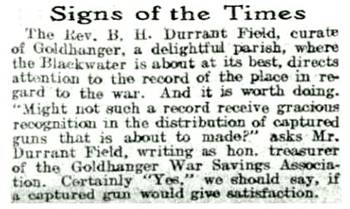
Captured field guns for the Churchyard
In 1919 when the rector was
planning and fund raising to built the war memorial
at the front of St. Peter’s Church he also had the
idea of installing two captured field guns either side of the memorial with
imposing new gates and pathway.
From the Parish magazine of
December 1918…
Our
Fallen
A meeting was held at the Rectory on
Thursday afternoon, November 14th, of the Parents and Relatives of those who
have been killed in the War… The Rector
(Revd Gardner) presided, the object of the meeting was to consider the erection
in the Churchyard, in front of the Tower, of a suitable Memorial. Various designs were considered. All were
unanimous in adopting a representation of the “Great Sacrifice” to be executed
in stone and about 20 feet in height, which it is hoped will be completed next
July, and which it is their intention to erect. The Rector, in the face of the
splendid record of Goldhanger in the War, has applied to the Authorities for
the grant of a German Field Gun to be placed in front of our Parish Memorial
which is to be erected in front of the Church Tower… It may then be possible to have new wide
gates and a wide path from the road to the Tower, to place the Memorial in the
centre of the path, and with the Gun in the foreground if granted would be a
noble completion.
At the same time the Revd.
Durrent Field wrote letters to the local newspaper and The Times publicising
the plan…

Goldhanger Creek privately hired
In 1919 the local newspaper
reported that a fisherman had attempted to hire Goldhanger Creek. The
application was refused by the Council…

Now one can only speculate why anyone would want to
“hire” the Creek: to create a fishing
fleet harbour? oyster beds? a salt extraction facility? a yacht club marina?
Blackwater estuary bird sanctuary
In 1938 Crawshay
Frost made a proposal for parts of the Blackwater
Estuary to made into a bird sanctuary which was publicised in the Essex
Chronicle...
WILD FOWL SANCTUARY - ESSEX HAS THE IDEAL
Essex
possesses a natural treasure which should be more widely featured. A few
notable Essex people, including the late Dr. J. H. Salter, have said and
written much to popularise the saltings
that stretch away from the River Blackwater along the Essex coast. Dr. Salters
famous Diary enchants us with delightful peeps of very early risers shooting
the wild duck and geese, which thrive in
their very own haunts around Tollesbury, Osea Island, and Goldhanger. Do the
majority of Essex people realise, though that these saltings offer the prospect
of one the finest sanctuaries for wild fowl in the county? The banks of the
Blackwater can show us the best breeding grounds of the hardiest flocks of
shell duck, wild geese, the cormorant and other wild birds.
Mr.
H. Crawshay Frost, of Sea View, Goldhanger, is one of a small group of Essex
natural history enthusiasts who look forward to the day when the Blackwater
shall be a sanctuary for the birds of the water preserved for ever as their
rightful home to all see, study and admire. Mr.
Crawshay Frost loves the Blackwater and every yard of its saltings. At
Sea View he has built a look-out over
the house which gives him an uninterrupted view of the water. He spends many
delightful hours, too down on the saltings watching the bird life, fresh
marvels of which reveal themselves at every visit. So entranced is he with all
he sees that he wants to pass on to others some of the beauty spots. Public
attention of this sort will hasten the day surely not far distant, when Essex
will be able to boast its own sanctuary for wild water fowl amid surroundings
second to none.
A flying boat airport on the Blackwater with a terminus on Osea
Island
After World War II the UK
Government sought to improve long distant air transport and in 1945
Saunders-Roe were asked to design a suitable plane. The SR-45
"Princess" flying boat was produced. Steps were then taken to find a
suitable site for a new flying boat airport to close to London. Chichester, Bradwell,
and Osea Island on the Blackwater were suggested
locations. The Osea Island proposal was that the terminal would be on the
island itself with a new causeway constructed to give road access to the
A12.
By 1952 only one
Saunders-Roe Princess flying boat was flying and the proposal came to
nothing. At the time it was said that
large land-based aircraft and airfields would be more economically and safer.
However it was also said that the government was influence by the USA which had
no interest in flying boats as middle America had no suitable stretches of
water.
Cricket pitch at Follyfaunts
In 1952 when the cricket pitch in “The Park” behind the
Rectory ceased to be financially viable because the farmer disposed of his
milking herd and converted the field to arable, Mr Julian Jenkinson offered to
build a new pitch and clubhouse in the field in the front of Follyfaunts House. However the cricket club
committee could not reach an agreement with Mr Jenkinson on how the field would
be managed, so the plan was not pursued and the club was wound up.
Wesleyan Chapel conversion to a butchers shop
The Wesleyan Chapel in Head Street closed down in
the 1967 and in 1970 the building was sold to the owners of The Limes next
door. They applied for planning permission to convert the Chapel into a
butchers shop. There were many objections however and permission was refused.
The Chapel became derelict and remained unused for many years.
Housing estate on the school field
In 1977 the village school closed and the Church of England sold the
building and the adjacent field to “Romford, Hornchurch, and Havering Church
School Trust” who ran a “study centre” there for ten years. In 1989 they
applied for planning permission to build houses on the field and there were
many objections and permission was refused. This is part of an article that
appeared in the local paper…

________________________________
return to..
top
of this page Did you know about... home